 2023, Vol. 59


系统性红斑狼疮(SLE)是一种复杂的涉及多个器官的自身免疫性疾病。肾脏受累是SLE病人死亡的主要原因之一。虽然狼疮性肾炎(LN)的总体预后在过去几十年中有所改善,但还有5%~26%的病人会发展为终末期肾病[1-2]。肾移植已被认为是治疗大多数狼疮性肾炎终末期肾病(LN-ESRD)的有效手段之一,能明显改善病人的生活质量及预后[3-5]。但肾移植为有创手术,并且要长期服用免疫抑制剂。另外,肾源短缺使得只有少数人有获得肾移植的机会。而且,肾移植治疗LN-ESRD仍存在一些问题需要解决:病人选择肾移植的最佳时机;病人面临因肾移植的一系列并发症如排斥、感染等导致移植肾丢失风险[6-7];LN-ESRD受者肾移植的临床效果、长期预后如何;肾移植术后LN的复发机率如何;肾移植对LN复发影响如何[8-9]。本研究对在我院行肾移植术LN-ESRD病人的临床资料进行回顾性分析,观察其临床效果及安全性,探讨肾移植作为LN-ESRD病人治疗手段的可行性。
1 资料及方法 1.1 研究对象1997年9月—2020年12月在青岛大学附属医院肾脏移植中心接受肾移植的LN-ESRD病人25例。病人均符合美国风湿病学会SLE的诊断标准。LN通过肾穿刺活检或以下其中之一确诊:肾病综合征、24 h尿蛋白>1 g或血尿。所有病人移植前均为LN稳定期,移植后于我院门诊定期随访。
1.2 研究方法收集病人的以下信息:年龄、性别、透析类型(血液透析或腹膜透析或未透析)、透析时间、随访时间(从移植日期到病人死亡或最后随访日期)。无论何种原因恢复透析或进行第2次移植均被定义为移植失败。肾穿刺活检用光学显微镜和免疫荧光技术进行评估,组织病理学诊断依据世界卫生组织和国际肾脏病学学会的分类标准,分为正常、LN复发、急性排斥反应、慢性移植肾肾病、血栓性改变、急性肾小管坏死和钙调神经磷酸酶抑制剂毒性[10]。记录肾移植术后免疫抑制方案、SLE肾或肾外表现、感染和排斥反应发生情况、移植物和病人生存情况。
1.3 统计分析使用SPSS 24.0软件进行数据统计分析,采用Kaplan-Meier法绘制累积生存曲线。
2 结果 2.1 一般资料有2例病人因失随访被排除,最终有23例病人纳入本研究。所有病人均接受1次肾移植,其中捐献者为死亡捐献者21例(91.3%),活体捐献者2例(8.7%)。23例病人,女性20例(87.0%),男性3例(13.0%);移植时年龄19~46岁,平均(33.8±8.2)岁。16例病人在肾移植前进行肾活检,其中75.0%的病例被证实为增生性病变(根据世界卫生组织和国际肾脏病学学会的分类为Ⅲ和Ⅳ级)。移植前15例(65.2%)病人接受血液透析治疗,5例(21.7%)病人接受腹膜透析治疗,其余病人未行透析治疗。透析时间为2~72个月,中位数为24个月。随访时间5~23年,平均(12.1±4.4)年。
2.2 术前诱导方案及术后维持方案术前行抗淋巴细胞球蛋白诱导10例(43.5%),抗胸腺细胞免疫球蛋白诱导治疗13例(56.5%)。术后维持性免疫抑制治疗方案为他克莫司(30.4%)和霉酚酸酯(69.6%)或环孢素(69.6%)和硫唑嘌呤(30.4%)联合泼尼松治疗。
2.3 并发症本研究中4例病人(17.4%)发生5次急性排斥反应,其中2例病人使用环孢素和硫唑嘌呤,2例病人使用他克莫司和霉酚酸酯;3次急性排斥反应发生在移植后第1个月,另2次分别发生在移植后第3个月和第6个月;应用抗胸腺细胞免疫球蛋白冲击疗法治疗后,肾功能均维持稳定。4例(17.4%)病人在移植后发生10次需要住院治疗的感染,其中病毒感染和细菌感染各4次,真菌感染2次(其中卡氏肺孢子菌感染1次)。所有感染均发生在移植后的前2年,均经药物治疗后痊愈。有1例病人在移植后8年出现SLE肾外表现,具体表现为皮肤紫癜、关节痛、抗dsDNA抗体阳性和补体C3水平下降,但其组织学上没有LN复发的证据,诊断为SLE临床复发,经增加糖皮质激素剂量后治疗成功。
2.4 病人及移植物长期生存率随访期间发生3例同种异体移植物丢失。移植肾丢失的原因为1例肾静脉血栓形成和2例慢性移植肾肾病,穿刺证实无LN复发。3例病人恢复到透析状态,其中2例病人在随访期间死亡,1例病人死于脑血管意外,另1例死于全身性感染,死亡时肾功能均正常。病人10年和15年累积生存率分别为95.2%和81.6%,移植肾累积生存率分别为90.3%和79.0%。见图 1。
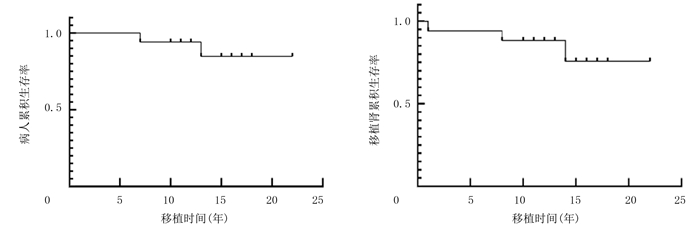 |
| 图 1 LN-ESRD移植病人及移植肾长期存活率 |
约20%的LN会在10年内发展至终末期肾病,LN-ESRD是导致SLE病人死亡的主要原因。病人进入LN-ESRD阶段需要频繁定期进行透析治疗,透析效果差并且带来一系列的并发症,例如高血压、心力衰竭、感染等,严重影响病人的生活质量和寿命[11]。国内外大样本的流行病学研究显示,LN-ESRD保守治疗病人长期生存率较低。我国大陆地区的数据显示,透析治疗10年和15年病人的生存率分别为89.0%和79.3%[12]。台湾地区的一项研究显示,透析治疗病人10年和15年生存率分别为75.1%和62.9%[13];另一项大样本研究显示,行保守治疗的病人10年生存率仅为65%[14]。KANG等[15]的研究显示,韩国腹膜透析病人10年生存率为81%,血液透析病人10年生存率仅为55%。一项美国的大样本研究显示,保守治疗病人10年生存率仅为33%[16]。肾移植是治疗LN-ESRD的有效手段之一。本中心23例LN-ESRD肾移植病人,其10年和15年的累积生存率分别为95.2%和81.6%,移植肾10年和15年的累积生存率分别为90.3%和79.0%。本中心LN-ESRD病人肾移植术后10年和15年的生存率明显高于以上国内外文献报道的保守治疗数据。国外的一项研究显示,LN-ESRD病人经肾移植治疗后10年和15年生存率分别为89.4%和84.1%,与本中心数据相仿[17]。
已有研究结果表明,肾移植受者的LN复发率较低[8-9, 18]。本研究仅有1例病人出现了SLE的肾外表现,但并未观察到LN复发的组织学证据。有2例慢性移植肾功能失常病人穿刺结果也排除了LN的复发。免疫抑制剂霉酚酸酯能有效抑制病人SLE活动,本研究也发现使用该免疫制剂可以明显降低SLE复发率和延缓其临床进展。
CONTRERAS等[19]报道,约43%的LN-ESRD病人因术后排斥反应造成同种异体肾移植失败。本研究中,4例病人发生急性排斥反应,但均没有移植物丢失。所有发生急性排斥反应的病人在应用药物控制后肾功能恢复正常。先前有研究指出,移植前血液透析时间越长,移植肾的预后越差,也有研究表明腹膜透析病人长期生存优于血液透析病人[8, 20]。本研究中2例移植物丢失发生在移植前接受血液透析的病人中。然而,由于病例数量有限,尚不能得出LN-ESRD病人移植前行腹膜透析具有优势。本研究2例接受环孢素联合硫唑嘌呤和泼尼松治疗的病人出现慢性移植肾肾病,导致移植物丢失;另1例移植后1周内出现肾静脉血栓造成移植物丢失。3例病人均不是因为排斥导致移植肾失功。
本研究中有4例病人发生10次感染,均发生在接受移植后的2年内,经治疗后病人感染得到控制。LN-ESRD病人死亡的主要风险因素为严重感染和心血管疾病等。钮凌颖等[21]通过长期随访发现,在行保守治疗的LN-ESRD病人中约36%曾出现感染,感染在全部死亡因素中占25%。感染增加的原因为:LN-ESRD病人体内存在包括脾脏功能减退和T细胞功能缺陷等多种免疫异常;治疗过程中使用大剂量糖皮质激素及免疫抑制剂;频繁进行腹膜透析或者血液透析等。本研究中发生感染者仅占全部病例的17.4%,较文献报道的保守治疗感染发生率低[22]。
本研究移植物和病人的长期存活率均明显高于国内外报道的大样本LN-ESRD保守治疗数据,与最近巴西、波兰、韩国等的研究结果相似[8, 23-25]。相较于传统的单一透析治疗,肾移植治疗相关并发症更少,病人长期生存率更高,并且可极大提高病人的生活质量。但本研究存在一定的局限性,如样本量较小、为回顾性研究、缺乏对照组,今后需要进行大样本的积累或进行临床前瞻性研究以进一步证实本研究结论。
总之,本文单中心回顾性研究表明,肾移植治疗LN-ESRD具有临床可行性,其临床疗效较好,并发症发生率低,远期预后较保守治疗具有明显优势。
| [1] |
MORONI G, VENTURA D, RIVA P, et al. Antiphospholipid antibodies are associated with an increased risk for chronic renal insufficiency in patients with lupus nephritis[J]. American Journal of Kidney Diseases: the Official Journal of the National Kidney Foundation, 2004, 43(1): 28-36. DOI:10.1053/j.ajkd.2003.09.011 |
| [2] |
PARIKH S V, ALMAANI S, BRODSKY S, et al. Update on lupus nephritis: core curriculum 2020[J]. American Journal of Kidney Diseases, 2020, 76(2): 265-281. DOI:10.1053/j.ajkd.2019.10.017 |
| [3] |
PLANTINGA L C, PATZER R E, DRENKARD C, et al. Association of time to kidney transplantation with graft failure among US patients with end-stage renal disease due to lupus nephritis[J]. Arthritis Care & Research, 2015, 67(4): 571-581. |
| [4] |
LÓPEZ-MORALES J M, QUINTANILLA-GONZÁLEZ L, RAMÍREZ-SANDOVAL J C, et al. Early outcomes in kidney transplant recipients with systemic lupus erythematosus[J]. Rheumatology International, 2019, 39(3): 479-487. DOI:10.1007/s00296-018-4234-7 |
| [5] |
ALBUQUERQUE B C, SALLES V B, TAJRA R D P, et al. Outcome and prognosis of patients with lupus nephritis submitted to renal transplantation[J]. Scientific Reports, 2019, 9(1): 11611. DOI:10.1038/s41598-019-48070-y |
| [6] |
BRODER A, MOWREY W B, GOLESTANEH L, et al. Methodological considerations in comparing access to Pre-emptive renal transplantation between SLE and other ESRD causes in the USRDS[J]. Seminars in Arthritis and Rheumatism, 2019, 48(4): 678-685. DOI:10.1016/j.semarthrit.2018.05.014 |
| [7] |
NTATSAKI E, VELO-GARCIA A, VASSILIOU V S, et al. Impact of pre-transplant time on dialysis on survival in patients with lupus nephritis[J]. Clinical Rheumatology, 2018, 37(9): 2399-2404. DOI:10.1007/s10067-018-4115-1 |
| [8] |
PHAM P T T, PHAM P C T. Graft loss due to recurrent lupus nephritis in living-related kidney donation[J]. Clinical Journal of the American Society of Nephrology: CJASN, 2011, 6(9): 2296-2299. DOI:10.2215/CJN.00190111 |
| [9] |
RAMIREZ-SANDOVAL J C, CHAVEZ-CHAVEZ H, WAGNER M, et al. Long-term survival of kidney grafts in lupus nephritis: a Mexican cohort[J]. Lupus, 2018, 27(8): 1303-1311. DOI:10.1177/0961203318770527 |
| [10] |
TAN E M, COHEN A S, FRIES J F, et al. The 1982 revised criteria for the classification of systemic lupus erythematosus[J]. Arthritis & Rheumatism, 1982, 25(11): 1271-1277. |
| [11] |
FANOURIAKIS A, KOSTOPOULOU M, CHEEMA K, et al. 2019 Update of the Joint European League Against Rheumatism and European Renal Association-European Dialysis and Transplant Association (EULAR/ERA-EDTA) recommendations for the management of lupus nephritis[J]. Annals of the Rheumatic Diseases, 2020, 79(6): 713-723. DOI:10.1136/annrheumdis-2020-216924 |
| [12] |
YANG J, LIANG D, ZHANG H, et al. Long-term renal outcomes in a cohort of 1814 Chinese patients with biopsy-proven lupus nephritis[J]. Lupus, 2015, 24(14): 1468-1478. DOI:10.1177/0961203315593166 |
| [13] |
TSAI W T, CHANG H C, WANG C T, et al. Long-term outcomes in lupus patients receiving different renal replacement therapy[J]. Wei Mian Yu Gan Ran Za Zhi, 2019, 52(4): 648-653. DOI:10.1016/j.jmii.2018.12.010 |
| [14] |
CHANG Y S, LIU C J, WU T H, et al. Survival analysis in systemic lupus erythematosus patients on maintenance dialysis: a nationwide population-based study in Taiwan[J]. Rheumatology (Oxford, England), 2013, 52(1): 166-172. DOI:10.1093/rheumatology/kes325 |
| [15] |
KANG S H, CHUNG B H, CHOI S R, et al. Comparison of clinical outcomes by different renal replacement therapy in patients with end-stage renal disease secondary to lupus nephritis[J]. The Korean Journal of Internal Medicine, 2011, 26(1): 60-67. DOI:10.3904/kjim.2011.26.1.60 |
| [16] |
CONTRERAS G, PAGAN J, CHOKSHI R, et al. Comparison of mortality of ESRD patients with lupus by initial dialysis modality[J]. Clinical Journal of the American Society of Nephrology: CJASN, 2014, 9(11): 1949-1956. DOI:10.2215/CJN.02500314 |
| [17] |
O'SHAUGHNESSY M M, LIU S, MONTEZ-RATH M E, et al. Kidney transplantation outcomes across GN subtypes in the United States[J]. Journal of the American Society of Nephro-logy: JASN, 2017, 28(2): 632-644. DOI:10.1681/ASN.2016020126 |
| [18] |
RODELO J, GONZÁLEZ L A, USTÁRIZ J, et al. Kidney transplantation outcomes in lupus nephritis: a 37-year single-center experience from Latin America[J]. Lupus, 2021, 30(10): 1644-1659. DOI:10.1177/09612033211028663 |
| [19] |
CONTRERAS G, MATTIAZZI A, SCHULTZ D R, et al. Kidney transplantation outcomes in African-, Hispanic- and Caucasian-Americans with lupus[J]. Lupus, 2012, 21(1): 3-12. DOI:10.1177/0961203311421208 |
| [20] |
SWAI J, ZHAO X X, NOUBE J R, et al. Systematic review and meta-analysis of clinical outcomes comparison between different initial dialysis modalities in end-stage renal disease patients due to lupus nephritis prior to renal transplantation[J]. BMC Nephrology, 2020, 21(1): 156. DOI:10.1186/s12882-020-01811-y |
| [21] |
钮凌颖, 周康兴, 王红. 系统性红斑狼疮患者合并感染临床特点及影响因素的分析[J]. 中国临床研究, 2016, 29(8): 1090-1092. |
| [22] |
JORGE A, WALLACE Z S, LU N, et al. Renal transplantation and survival among patients with lupus nephritis: a cohort study[J]. Annals of Internal Medicine, 2019, 170(4): 240-247. DOI:10.7326/M18-1570 |
| [23] |
GOŁEBIEWSKA J, DEBSKA-SLIZIEÑ A, BUŁŁO-PION-TECKA B, et al. Outcomes in renal transplant recipients with lupus nephritis-A single-center experience and review of the literature[J]. Transplantation Proceedings, 2016, 48(5): 1489-1493. DOI:10.1016/j.transproceed.2016.02.061 |
| [24] |
KIM J E, KIM Y C, MIN S L, et al. Transplant outcomes in kidney recipients with lupus nephritis, and systematic review[J]. Lupus, 2020, 29(3): 248-255. DOI:10.1177/0961203320902524 |
| [25] |
PAMPA-SAICO S, MARCÉN-LETOSA R, FERNÁNDEZ-RODRÍGUEZ A, et al. Kidney transplantation in systemic lupus erythematosus: outcomes and prognosis[J]. Medicina Clinica, 2019, 153(12): 460-463. DOI:10.1016/j.medcli.2018.09.016 |