 2021, Vol. 57


甲状腺木乃伊结节(MNs)是指在腺体内的囊性或囊实性结节,囊液逐渐被吸收后形成的小结节。有多种命名:塌陷结节[1]、僵尸结节[2-3]、消失的肿瘤[4-5]、MNs[6-7]等。MNs可自发形成,也可继发于粗针穿刺活检(CNB)[2-3, 8]、细针穿刺活检(FNA)[5-7, 9-12]或乙醇硬化治疗后[13]。MNs声像图多表现为低或极低回声、边界不清、微钙化、纵横比大于1等可疑恶性征象[14-20],极易误诊[13]。且部分结节FNA亦不能得到满意的结果[21-23]。为提高医师对MNs的诊断能力,本文在总结MNs病理改变的基础上,着重对其声像图特征及相关研究进展予以综述。
1 MNs的病理学改变LIVOLSI等[10]和PANDIT等[24]于1994、2001年先后发现,对甲状腺结节进行FNA后可能会出现一系列令人担忧的组织学改变(WHAFFT),包括以出血、肉芽组织形成、包膜扭曲变形等为主的急性期改变(多发生在FNA后3周内)及以纤维化和核异型为主的慢性期改变(多在FNA后3周后),且发生率高达38.49%。REN等[25]将MNs退变的过程分为3期:早期、出血消退期和慢性期。早期:细胞病理表现为大量机化的红细胞、少量含铁血黄素的巨噬细胞及少量可疑的微钙化等。出血消退期:包含弥漫性基质纤维化、慢性炎性细胞和组织细胞沉积等。慢性期:包含致密的基质纤维化,伴或不伴钙化,可见细胞异型,滤泡细胞少。其他学者研究亦证实甲状腺结节穿刺后会出现WHAFFT[26-28]。
2 MNs的高频超声声像图特征 2.1 体积缩小体积缩小(图 1A、B)是MNs最特异也是最有诊断价值的特征。KOO等[14]发现FNA后,88%(29/33例)MNs出现体积缩小。LACOUT等[7]的研究结果也显示,在12~61个月(平均28个月)的密切随访期间,MNs的体积缩小比例约为45%。
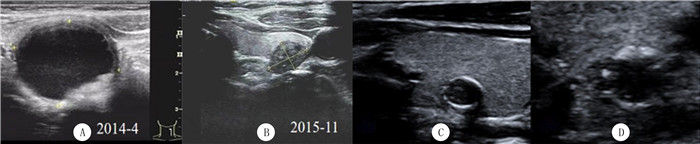 |
| A、B为1例病人甲状腺结节体积缩小观察。A:2014年4月左叶囊性为主的结节,最大径为2.7cm;B: 2015年11月复查,结节体积缩小,最大径为1.0 cm,并出现“双边征”及内环上点状钙化。C、D显示甲状腺结节钙化。C:结节周边不连续壳状钙化;D:放大图像后,观察到钙化外有确切的实性低回声成分,手术病理证实为PTC。 图 1 MNs体积缩小和不连续钙化的高频超声声像图特征 |
MNs多表现为实性低或极低回声,其原因可能是结节内部坏死、纤维化及囊液吸收/浓缩所致[2, 7, 15-16, 28]。在固缩过程中,结节内部的界面效应、纤维化和钙化等可导致其后方回声衰减,难以与甲状腺乳头状癌(PTC)鉴别。
2.3 形态和边缘MNs多表现为纵横比大于1或边缘不规则。前者可能是在结节萎缩塌陷过程中,不对称的纤维愈合/收缩(特别是横向收缩)所致[7],而后者主要是由于包膜塌陷、皱缩、扭曲、周围炎性反应及组织牵拉等所致[9]。
2.4 钙化表现MNs中可出现多种钙化,包括弧形/环形/壳状钙化、粗大钙化和微钙化等[14]。弧形/环形/壳状钙化多出现在结节周边,是结节木乃伊化的终末阶段[7]。然而,当壳状钙化不连续或钙化外有确切的实性低回声成分时,要警惕恶性的可能[29](图 1C、D)。粗大钙化多位于结节的中心或略偏心,多是原囊实性结节中实性成分发生退变和钙化所致。微钙化大部分是结节囊性成分中的胶质浓集而成,多位于中心或偏心部、聚集分布,周围多有小囊变区和“彗星尾”征[14, 30-31]。
2.5 血供特点MNs彩色多普勒(CDFI)检查时,多表现为无血供[7]。但少部分MNs可以“复活”[32],重新出现血流信号和体积增大。微小PTC结节内部多无血供,结节周边有时可见较多血流,形成一个“包围圈”[34-36];但随着结节变大,高血供者所占比例上升,且以内部树枝状血供为主[33, 35-38]。因此,CDFI对<1 cm的MNs诊断价值比较有限。超声造影(CEUS)可以弥补CDFI的不足,更精确地显示结节血流灌注情况及血流动力学状态的变化。MNs多表现为内部无增强或少许条索状增强,峰值强度比<1和曲线下面积比<1[7, 39-40]。而PTC则多表现为低增强、不均匀增强、边缘不规则增强等血供特点[41-46]。因此,CEUS可以为鉴别MNs和PTC提供一定的依据。
2.6 特殊征象——“双边征”“双边征”是由KO等[1]于2012年首次提出的MNs特殊征象,2016年LACOUT等[7]首次予以详细解释和介绍。它是MNs与微小PTC鉴别中最具有提示意义的征象,准确度高达85%[1, 7, 47-48]。TAN等[50]对193例MNs和109例PTC对照研究发现,该征象对甲状腺良恶性结节的诊断特异度为99.9%。
在高频声像图上,“双边征”多表现为平行/近乎平行的两个环,可占据结节一半以上的边缘部(图 2A~C):内环纤细连续,为等/略高/强回声;外环略厚或厚薄欠均匀,为低回声。内环的病理基础为皱缩过程中未被累及或遮挡而保留下来的囊壁结构,外环则为皱缩的囊壁、炎性反应带、纤维化等。值得注意的是,“双边征”在结节不同固缩状态下,有不同的表现,如囊壁收缩征[49]、指纹征或同心圆征[49]和壳状钙化等。囊壁收缩征:是指结节边缘的高回声晕,通常不完整,在其外缘可见裂隙样低回声。指纹征:当某一个方向上(如水平位)吸收比较少,而垂直位吸收比较多时,声像图表现为低回声环和高回声环呈条纹状交错出现(图 2D)。同心圆征:各方位对称性吸收,声像图表现为一个完整的低回声晕和高回声环相互嵌套而成,中央为尚未完全吸收的液性成分(图 2E)。当囊液完全被吸收后,结节进入木乃伊化的终末阶段,边缘的高回声环形成壳状或弧形强回声(图 2F)。另外,“双边征”中的低回声外环需要与PTC周边的低回声晕相鉴别,PTC的低回声晕与癌结节纤维假包膜、周边绕行血管、周围组织受压或浸润等有关[7, 46]。TAN等[49]研究表明,19.7%的MNs和37.6%的PTC可以发现晕征。因此,晕征不能鉴别良恶性结节。
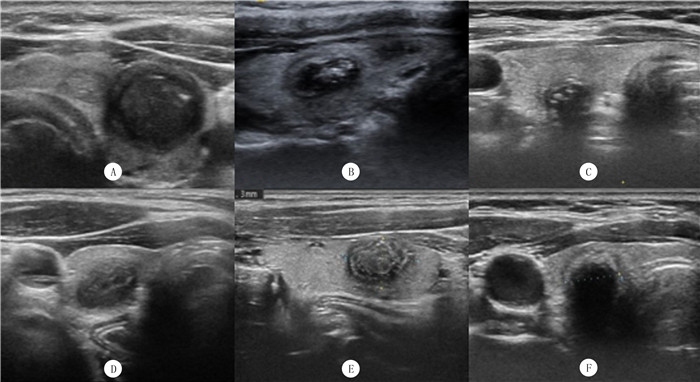 |
| A~F为MNs“双边征”,A、B、C显示双边分别占据结节周长的100%、75%、50%;D、E、F分别为MNs“指纹征”、“同心圆征”、壳状钙化。 图 2 MNs“双边征”的高频超声声像图特征 |
MNs与PTC的鉴别是高频超声诊断的难点,需要注意以下3点。①MNs和PTC的声像图特征交叉颇多,当发现可疑MNs时,应首先询问既往病史,若没有确切病史的支持,MNs的诊断应慎重。②对于囊变出血、乙醇硬化或射频消融等介入性治疗的结节,应充分解释和提示,避免后续因为结节发生木乃伊化而误诊。③FNA检查后1~3周内,由于穿刺造成的结节内出血,可能出现“双边征”等酷似MNs的征象,应警惕。
总之,充分认识MNs的发生机制和演变过程,对理解其声像图特征有帮助。目前有关MNs的超声声像图特征研究还非常有限,亟需大样本的总结和分析,以进一步提高超声医师的鉴别诊断能力。
| [1] |
KO M S, JEONG K S, SHONG Y K, et al. Collapsing benign cystic nodules of the thyroid gland: sonographic differentiation from papillary thyroid carcinoma[J]. AJNR American Journal of Neuroradiology, 2012, 33(1): 124-127. DOI:10.3174/ajnr.A2732 |
| [2] |
HA E J, BAEK J H, LEE J H, et al. Sonographically suspicious thyroid nodules with initially benign cytologic results: the role of a core needle biopsy[J]. Thyroid: Official Journal of the American Thyroid Association, 2013, 23(6): 703-708. DOI:10.1089/thy.2012.0426 |
| [3] |
LEE H Y, BAEK J H, HA E J, et al. Malignant-looking thyroid nodules with size reduction: core needle biopsy results[J]. Ultrasonography (Seoul, Korea), 2016, 35(4): 327-334. |
| [4] |
KHOLOVÁ I. Vanishing thyroid gland tumors: infarction as consequence of FNA[J]. Diagnostic Cytopathology, 2016, 44(7): 568-573. DOI:10.1002/dc.23479 |
| [5] |
BHATIA P, DENIWAR A, MOHAMED H E, et al. Vani-shing tumors of thyroid: histological variations after fine needle aspiration[J]. Gland Surgery, 2016, 5(3): 270-277. DOI:10.21037/gs.2016.01.05 |
| [6] |
LACOUT A, CHEVENET C, MARCY P Y. Suspicious thyroid nodule management with nondiagnostic results at cytolo-gic examination: how to diagnosis mummified benign thyroid nodules[J]. Radiology, 2015, 277(1): 303-304. DOI:10.1148/radiol.2015150912 |
| [7] |
LACOUT A, CHEVENET C, MARCY P Y. Mummified thyroid syndrome[J]. AJR American Journal of Roentgenology, 2016, 206(4): 837-845. DOI:10.2214/AJR.15.15267 |
| [8] |
HA S M, BAEK J H, CHOI YJ, et al. Malignancy risk of initially benign thyroid nodules: validation with various thyroid imaging reporting and data system guidelines[J]. Eur Radiol, 2019, 29(1): 133-140. DOI:10.1007/s00330-018-5566-0 |
| [9] |
BOLAT F, KAYASELCUK F, NURSAL T Z, et al. Histopathological changes in thyroid tissue after fine needle aspiration biopsy[J]. Pathology, Research and Practice, 2007, 203(9): 641-645. DOI:10.1016/j.prp.2007.05.004 |
| [10] |
LIVOLSI V A, MERINO M J. Worrisome histologic alterations following fine-needle aspiration of the thyroid (WHAFFT)[J]. Pathology Annual, 1994, 29(Pt 2): 99-120. |
| [11] |
POLYZOS S A, PATSIAOURA K, ZACHOU K. Histological alterations following thyroid fine needle biopsy: a syste-matic review[J]. Diagnostic Cytopathology, 2009, 37(6): 455-465. DOI:10.1002/dc.21055 |
| [12] |
AULICINO M R, KANEKO M, UINGER P D. Excessive endothelial cell proliferation occurring in an organizing thyroid hematoma: report of a case and review of the literature[J]. Endocrine Pathology, 1995, 6(2): 153-158. DOI:10.1007/BF02739878 |
| [13] |
PARK N H, KIM D W, PARK H J, et al. Thyroid cysts treated with ethanol ablation can mimic malignancy during sonographic follow-up[J]. Journal of Clinical Ultrasound: JCU, 2011, 39(8): 441-446. DOI:10.1002/jcu.20861 |
| [14] |
KOO J H, SHIN J H, HAN B K, et al. Cystic thyroid no-dules after aspiration mimicking malignancy: sonographic cha-racteristics[J]. Journal of Ultrasound in Medicine: Official Journal of the American Institute of Ultrasound in Medicine, 2010, 29(10): 1415-1421. |
| [15] |
HA E J, BAEK J H, LEE J H, et al. A focal marked hypoechogenicity within an isoechoic thyroid nodule: is it a focal malignancy or not[J]. Acta Radiol, 2015, 56(7): 814-819. DOI:10.1177/0284185114539322 |
| [16] |
JUNG S L, JUNG C K, KIM S H, et al. Histopathologic fin-dings related to the indeterminate or inadequate results of fine-needle aspiration biopsy and correlation with ultrasonogra-phic findings in papillary thyroid carcinomas[J]. Korean J Radiol, 2010, 11(2): 141-148. DOI:10.3348/kjr.2010.11.2.141 |
| [17] |
CHUNG S R, BAEK J H, PARK H S, et al. Ultrasound-pathology discordant nodules on core-needle biopsy: malig-nancy risk and management strategy[J]. Thyroid, 2017, 27(5): 707-713. DOI:10.1089/thy.2016.0462 |
| [18] |
MOON H J, KIM E K, KWAK J Y. Malignancy risk stratification in thyroid nodules with benign results on cytology: combination of thyroid imaging reporting and data system and Bethesda system[J]. Annals of Surgical Oncology, 2014, 21(6): 1898-1903. DOI:10.1245/s10434-014-3556-2 |
| [19] |
KIM S S, KIM M R, MOK J Y, et al. Benign cystic nodules may have ultrasonographic features mimicking papillary thyroid carcinoma during interval changes[J]. Endocrine Journal, 2011, 58(8): 633-638. DOI:10.1507/endocrj.K11E-095 |
| [20] |
黄莉, 赵艳娜, 顾建华, 等. 超声检查在甲状腺囊实性结节随访中的应用价值[J]. 中华医学超声杂志(电子版), 2020, 17(12): 1189-1192. DOI:10.3877/cma.j.issn.1672-6448.2020.12.008 |
| [21] |
YEON J S, BAEK J H, LIM H K, et al. Thyroid nodules with initially nondiagnostic cytologic results: the role of core-needle biopsy[J]. Radiology, 2013, 268(1): 274-280. DOI:10.1148/radiol.13122247 |
| [22] |
SCREATON N J, BERMAN L H, GRANT J W. US-guided core-needle biopsy of the thyroid gland[J]. Radiology, 2003, 226(3): 827-832. DOI:10.1148/radiol.2263012073 |
| [23] |
COCHAND-PRIOLLET B, VIELH P, ROYER B, et al. Cytopathologie thyroïdienne: le système de Bethesda 2010 (thyroid cytopathology: bethesda system 2010)[J]. Ann Pathol, 2012, 32(3): 177-183. DOI:10.1016/j.annpat.2012.02.015 |
| [24] |
PANDIT A A, PHULPAGAR M D. Worrisome histologic alterations following fine needle aspiration of the thyroid[J]. Acta Cytologica, 2001, 45(2): 173-179. DOI:10.1159/000327273 |
| [25] |
REN J, BAEK J H, CHUNG S R, et al. Degenerating thyroid nodules: ultrasound diagnosis, clinical significance, and management[J]. Korean Journal of Radiology, 2019, 20(6): 947-955. DOI:10.3348/kjr.2018.0599 |
| [26] |
BALOCH Z W, LIVOLSI V A. Post fine-needle aspiration histologic alterations of thyroid revisited[J]. American Journal of Clinical Pathology, 1999, 112(3): 311-316. DOI:10.1093/ajcp/112.3.311 |
| [27] |
ERSÖZ C, SOYLU L, ERKOÇAK E U, et al. Histologic alterations in the thyroid gland after fine-needle aspiration[J]. Diagnostic Cytopathology, 1997, 16(3): 230-232. DOI:10.1002/(SICI)1097-0339(199703)16:3<230::AID-DC7>3.0.CO;2-J |
| [28] |
KIM J H, NA D G, LEE H. Ultrasonographic echogenicity and histopathologic correlation of thyroid nodules in core needle biopsy specimens[J]. Korean Journal of Radiology, 2018, 19(4): 673. DOI:10.3348/kjr.2018.19.4.673 |
| [29] |
PARK Y J, KIM J A, SON E J, et al. Thyroid nodules with macrocalcification: sonographic findings predictive of malignancy[J]. Yonsei Med J, 2014, 55(2): 339-344. DOI:10.3349/ymj.2014.55.2.339 |
| [30] |
ELLISON E, LAPUERTA P, MARTIN S E. Psammoma bodies in fine-needle aspirates of the thyroid: predictive value for papillary carcinoma[J]. Cancer, 1998, 84(3): 169-175. DOI:10.1002/(SICI)1097-0142(19980625)84:3<169::AID-CNCR9>3.0.CO;2-J |
| [31] |
WU G, ZHOU Z W, LI T Y, et al. Do hyperechoic thyroid nodules on B-ultrasound represent calcification[J]. The Journal of International Medical Research, 2013, 41(3): 848-854. DOI:10.1177/0300060513480083 |
| [32] |
LACOUT A, CHEVENET C, MARCY P Y. Reverse mummified thyroid syndrome[J]. AJR American Journal of Roentgenology, 2016, 207(2): W23. DOI:10.2214/AJR.16.16349 |
| [33] |
计静丹, 詹维伟, 徐上研. 彩色多普勒超声鉴别甲状腺结节良恶性价值的再探讨[J]. 中华医学超声杂志(电子版), 2011, 8(6): 1289-1295. DOI:10.3877/cma.j.issn.1672-6448.2011.06.022 |
| [34] |
SPIEZIA S, FARINA R, CERBONE G, et al. Analysis of co-lor Doppler signal intensity variation after levovist injection: a new approach to the diagnosis of thyroid nodules[J]. J Ultrasound Med, 2001, 20(3): 223-233. DOI:10.7863/jum.2001.20.3.223 |
| [35] |
池英姬, 崔玲艳, 孙艺宁, 等. 微细血流成像技术联合ACR-TI RADS分类法在甲状腺结节诊断中的应用价值[J]. 中国超声医学杂志, 2021, 37(4): 371-375. DOI:10.3969/j.issn.1002-0101.2021.04.004 |
| [36] |
LACOUT A, MARCY P Y. Highlights on power Doppler US of thyroid malignancy[J]. Radiology, 2010, 257(2): 586-587;authorreply587. DOI:10.1148/radiol.100940 |
| [37] |
侯苏芸, 贾晓培, 崔可飞, 等. 血流特征对甲状腺结节良恶性鉴别的价值探讨[J]. 中国超声医学杂志, 2018, 34(4): 296-299. DOI:10.3969/j.issn.1002-0101.2018.04.003 |
| [38] |
MOON H J, KWAK J Y, KIM M J, et al. Can vascularity at power Doppler US help predict thyroid malignancy[J]. Radio-logy, 2010, 255(1): 260-269. DOI:10.1148/radiol.09091284 |
| [39] |
PENG Q H, NIU C C, ZHANG Q R, et al. Mummified thyroid nodules: conventional and contrast-enhanced ultrasound features[J]. Journal of Ultrasound in Medicine, 2019, 38(2): 441-452. DOI:10.1002/jum.14712 |
| [40] |
陈思洁, 彭清海, 刘明辉, 等. 甲状腺木乃伊结节的常规超声、声触诊组织量化成像及超声造影表现[J]. 临床超声医学杂志, 2020, 22(1): 25-29. DOI:10.3969/j.issn.1008-6978.2020.01.009 |
| [41] |
RUBALTELLI L, BELTRAME V, TREGNAGHI A, et al. Contrast-enhanced ultrasound for characterizing lymph nodes with focal cortical thickening in patients with cutaneous melanoma[J]. AJR American Journal of Roentgenology, 2011, 196(1): W8-W12. DOI:10.2214/AJR.10.4711 |
| [42] |
YU M, LIU Q, SONG H P, et al. Clinical application of contrast-enhanced ultrasonography in diagnosis of superficial lymphadenopathy[J]. Journal of Ultrasound in Medicine, 2010, 29(5): 735-740. DOI:10.7863/jum.2010.29.5.735 |
| [43] |
CATALANO O, SETOLA S V, VALLONE P, et al. Sonography for locoregional staging and follow-up of cutaneous me-lanoma: how we do it[J]. Journal of Ultrasound in Medicine, 2010, 29(5): 791-802. DOI:10.7863/jum.2010.29.5.791 |
| [44] |
李逢生, 韩琴芳, 徐荣, 等. 超声造影在甲状腺乳头状癌诊断中的初步研究[J]. 中国超声医学杂志, 2013, 29(1): 1-3. DOI:10.3969/j.issn.1002-0101.2013.01.001 |
| [45] |
刘婷, 冯晓蕾, 周琦, 等. 超声造影和弹性成像对不同大小甲状腺乳头状癌检出敏感性的探讨[J]. 中华超声影像学杂志, 2013(4): 321-324. DOI:10.3760/cma.j.issn.1004-4477.2013.04.013 |
| [46] |
种静, 孙咏梅, 宁春平, 等. 甲状腺乳头状癌超声造影特征与微血管密度及微血管面积的相关性研究[J]. 中华医学超声杂志(电子版), 2017, 14(4): 274-279. DOI:10.3877/cma.j.issn.1672-6448.2017.04.008 |
| [47] |
王丽娜, 李俊林. 甲状腺良性囊性皱缩结节与微小乳头状癌的超声鉴别诊断[J]. 内蒙古医科大学学报, 2020, 42(4): 354-357, 364. |
| [48] |
李维生. 甲状腺木乃伊结节的超声特征分析[J]. 家庭医药, 2019(5): 129. |
| [49] |
TAN X Q, QIAN L X, WANG Y H. Distinguishing mummified thyroid nodules from malignant thyroid nodules[J]. Medical Ultrasonography, 2019, 21(3): 251-256. DOI:10.11152/mu-1894 |